Sunday, December 5, 2010

sin changes us, but not God


Homily
Tuesday of the 2nd Week of Advent
St. Ambrose, bishop and doctor
7 December 2010
St. Michael the Archangel School Mass

God comes closer and closer and closer. That is the great proclamation of Advent. Against all deistic tendencies, against all temptations to think that God is absent, the Advent proclamation, spoken with conviction again today by the prophet Isaiah, is that God is coming closer. He is always coming closer. Here He comes, with power, who rules with His strong arm, with His reward with Him. He comes like a shepherd who feeds his flock, carrying in His arms His lambs, carrying them in His bosom.

The mystery of the Incarnation is the mystery of God's coming closer. He comes to shepherd His people, following them wherever they go, no matter how far they stray from Him. When we strayed so far that there did not seem to be a way back for us, God not only pursued us, leaving everything else aside to rescue those of us who had thrown Him aside, He Himself became the lamb, taking on our nature, and then even more, taking our sins upon Himself in order to bear the punishment of death in our stead.

Our sins prevent our ability to be present to God, and so we must repent of them with all our hearts, for the Lord will not rescue us without ourselves. Yet lest we think that our sins prevent God's ability to be present to us, God came closer, taking on our human nature and even its sinfulness, so that no matter how far we have strayed, our sins do not prevent God from being present to us.

Let us rejoice in the mystery that although we have millions of ways to move away from God, we never change His desire to come closer to us, and let us marvel that He has tens of millions of ways to make Himself present wherever we are. No matter how we have sinned, He wishes to carry us back in His own arms.

Saturday, December 4, 2010

you're in jesus' way!

Homily
2nd Sunday of Advent
5 December 2010
St. Lawrence Catholic Center

You are in Jesus' way. Your ego. Your plans. Your stuff. Your sins. John the Baptist comes on the 2nd Sunday of Advent to remind us that we are the problem. Notice that I changed from you to we there. I'll throw myself in as part of the problem as well. We are in Jesus' way. The reason so few things change is that most of us are self-absorbed. Life is a self-improvement project for us. John the Baptist comes on this second Sunday of Advent to remind us not to equivocate the Lord's coming with another opportunity to tinker with our own lives. The Lord's coming is not another revolutionary diet, not another revolutionary workout, not another once in a lifetime investment opportunity, nor is it the perfect material gift at a price too good to be true. No matter how dramatic the commercials and infomercials make these things sound, in the end they are about small adjustments, not real conversion, not real change. John the Baptist wears camel hair and eats locusts to try to get us not to equivocate the Lord's coming with any other special offers that bombard us during this holy season. No, the Lord's coming is different because it is a change of focus. Our life is not about us. Our life is not about self-improvement, it is about self-forgetfulness. John the Baptist is the greatest prophet because his message is the most powerful. If we are to recognize the Lord's coming, it requires a complete re-orientation of our lives. Our life is not about us, it is about God and neighbor. If our focus is anywhere else, we are part of the problem.

Repentance, then, is central to the prophecy of John. We do not spend as long detaching from sin in Advent than we do in Lent, nor do we engage in the penitential practices of prayer, fasting and almsgiving. But real repentance has to be a part of a real Advent. Actually, for some of us, we give more alms during Advent than Lent, and this is good, for giving our stuff and our money away is a cleansing practice, one of the three best ways to detach ourselves from ourselves, and from our sins. John the Baptist can help us be better shoppers then. If the message of John the Baptist gets through to us, our shopping habits should change not based on how the economy is doing, but should reflect that Christ is present, that welcoming His presence is the reason of the season. The goal is to become more generous, not less, but the gifts we give are a way of expressing the coming of Christ, not a replacement for Him or a distraction from Him. John the Baptist in requiring us to detach from our sins reminds us of what we know to be true, that we will not allow Christ to come if our lives are already too full, too full of our own pride and self-absorption. If Christ is to move in, something has to move out. We must repent of our sins. So make a good confession this Advent, one in which you sincerely act to move away from the temptations that threaten to dominate your life.

Heeding the prophecy of John the Baptist should make us want to do something to ensure that this Christmas is different. Perhaps many of the traditions we have are great traditions, and externally, it really is a beautiful season with so many opportunities to focus on what is important. Yet can we afford to let yet another Christmas go by when thousands of things happen externally, but almost nothing changes on the inside. Can we go through the motions yet another year? When John the Baptist speaks about a baptism of fire, he is saying that Christmas, the coming of Jesus, is not just a gentle reminder from God to focus on the most important things. Our problem is not that we don't know what's important, it's that we can put it off to tomorrow, while working on ourselves today. The reason so little changes each Christmas in our interior life is not that we are ignorant of what is important, it is that we do not really know that Christ is present. John the Baptist shouts at us to do whatever we can, in a desperate way, to get out of the illusion that Christ is distant, that we can control His coming and going by tinkering with our lives. He tells us to get over ourselves, and to realize that we control nothing, and that our freedom only gets greater when shared with God. John the Baptist is not about tinkering. He invites us to a complete re-orientation away from self and toward God, and he challenges us to let ourselves be baptized by the Lord's coming, a baptism by the Holy Spirit and by fire.

Friday, December 3, 2010

what are we seeing?


Homily
Memorial of Francis Xavier
3 December 2010
Danforth Chapel, University of Kansas

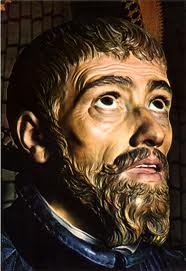
Francis Xavier as one of the great missionaries in Church history got to see a lot of things. Bringing the Gospel to the new lands of India and China, Francis only saw opportunity to teach, to baptize, to bring the good news of the Incarnation that God is truly with His people. Francis Xavier wrote to Ignatius of Loyola, the founder of the Jesuits, how people's lives would be changed if they could see what he saw, and what a joyful mission it was to share the truth of the Gospel with those who had never heard it.

Even in Francis Xavier's time, there were those who had been surrounded by the Gospel all their lives and yet did not know the Lord, did not see the Lord. Francis Xavier abhorred that souls were being lost because Christians hid their faith, and lacked the courage to be missionaries. The blind men in today's Gospel are different. The blind men remind us that then, and now, just because we are living in a Christian culture, albeit an increasingly agnostic and secular one, doesn't mean that we see the Lord. The blind men who saw nothing were one of the few to see the Lord. This lack of seeing is especially true in the Eucharist. Jesus promised to be with us in this perfect way, but many cannot and will not see Him here. The blind men in today's Gospel teach us what it is like to see with eyes of faith. Many people with perfect sight but no faith did not find Jesus because they were not looking for him, yet the blind men with no sight but great faith could see Him perfectly. In the same way, those of us with perfect sight can see millions of things everyday but can go a whole day through without ever seeing Jesus, but those with faith can see nothing but Christ and His presence in the world.

If we have made room for Christ, and sincerely look for His coming, as Advent encourages us to do, then we will find ourselves a bit more like Francis Xavier. The blind men, having had a real conversion through the encounter with Jesus, even without his permission could not stop telling people about Him. The great Francis Xavier, who could not stop seeing Christ in the people he met in the Far East, died witnessing to this same Christ who was always with him.

Wednesday, December 1, 2010

focus on what is present, not what is lacking


Homily
Wednesday of the 1st Week of Advent A
St. Lawrence Catholic Campus Center
1 December 2010
For daily readings click here


We are a nation that diets incessantly and yet still gains weight. We are a nation where the more we have, the less we give. We are a nation that despite our ability to work harder and get things done more efficiently, finds itself increasingly slothful and depressed. We have more entertainment options, and yet people are lonelier than ever. We yearn for true enduring love, and yet marriage is on the decline. We are an inherently ungrateful people, who focus habitually not on rejoicing in what is present, but in lamenting what we perceive to be lacking.


It has always been true that if a person is fulfilled and happy on the inside, there is no way to make them unhappy, and vice versa. There are people who in poverty only see superabundance of opportunity and gifts, and those in abundance who only see unfulfilled desire and who only know boredom.


Today's scriptures remind us that the Lord sees the world, and has each one of us in His hands. He knows our needs before we ask Him, and through His Son every human longing has been satisfied in superabundance, so that not only can we say that the Lord is my shepherd, I shall not want, but we can without reservation share what we have in faith with those who have no faith. For with the Lord there is superabundance, and to the one who has much, more will be given, and He will grow rich in what matters to God, but for the one who has not, even what he has, will be taken away.

Tuesday, November 30, 2010

Andrew was first

Homily
Feast of Andrew, Apostle
St. Lawrence Catholic Campus Center
30 November 2010
For daily readings click here
The vocation story of one of our youngest seminarians is almost too simple to be true. As a senior in high school, he was sitting around with his siblings discussing whether to go to KU or Rockhurst University. He was interested in being an orthopedic doctor at that time, and was weighing the merits of both schools. One of his sisters said somewhat out of the blue - maybe you should be a priest. Our seminarian said to her - you know I probably should be. His mother caught wind of it and told him to call the vocation director. The next day he was signing up for seminary. I'm not kidding. This is a true story.
Not every vocation story is this simple on the outside. And as this seminarian gets into formation, he realizes that he has much work to do on the road to priesthood. Most vocation stories, like mine, are pretty complicated when told out loud. I ran away from my priestly vocation tens of thousands of times. Part of me always knew I should be a priest, but there were thousands of reasons I could think of for waiting to call the vocation director. Yet in the end, it all worked out.
What strikes us about the calling of Peter and Andrew, James and John, is the simplicity of the story. It is too simple to be true. We wonder what Matthew is leaving out of the story, for these four apostles, like us, surely had tens of thousands of hesitations, quid pro quos and questions that are left out of the story. We think the apostles must be like us, who do not respond to the Lord's voice so simply. Maybe it is easier for us to doubt Christ today, but probably not. Those apostles could have told Jesus to jump in the lake. But they didn't. What we see in the calling of the first four apostles is the core of what constitutes a vocation. Christ calls. We leave everything and follow Him. Christ calls, and because He loves us with a perfect love, and knows us better than we know ourselves, we take His voice as an absolute authority, and because we prefer nothing to being with Him, we detach ourselves from our sins, our things, our plans, and our every desire in order to follow Him perfectly. In reality, it gets complicated, but a true vocation always goes back to this simplicity that we see in tonight's Gospel.
Andrew, then, is honored to be the first apostles to hear and to respond. His is the first apostolic vocation, and one we celebrate on his feast with great joy! Andrew's vocation shows us that holiness consists in simplicity. He was called to be a fisher of men, to be someone through whom Christ could know and love His people, someone through whom the Lord could capture His people. Anyone who responds to a vocation from Christ knows that it is not we who choose Christ, but Christ who captures us in His net of pure love, and because He is active within us, we share in this mission of fishing for men, this ministry of capturing souls for His eternal kingdom. St. Andrew is the first vocation director, introducing his brother Simon to Jesus. So say a prayer on this feast for your local vocation director, if you know who he is.
Andrew and Simon follow Jesus together. So do James and John. The first apostles come in pairs. One of the mistakes I made in joining the seminary was failing to bring someone with me. I should have tried harder to bring a friend to seminary with me. While it is true that vocations can be heard and answered in isolation, anyone knows that there is wisdom in strength in doing things together, and this includes responding to vocations. If the Lord is calling you, ask Him today if He is calling someone close to you. Talk to that person. Perhaps your responding together will be the key to either of you responding at all.


Sunday, November 28, 2010

when nothing is happening stay awake, be ready

Reflection for the 1st Sunday of Advent Year A
28 November 2010
St. Lawrence Catholic Campus Center
For daily readings click here

Welcome to the new liturgical year, the first Sunday of Advent. If we had to chart our liturgical year along the hours of a day, the first Sunday of Advent would be nightfall. Just when we are relieved that the bustle of the day is over, when the temptation to have a beer and kick back and watch television and forget about the troubles of day is strongest, the Church tells us to stay alert. Be ready. This is the season of Advent. When the rest of the world is getting drowsy, we are to become more alert. It is when things seem to be slowing down that we are told to look for something important to happen.

If we had to plot Christmas along the hours of the day, the Lord's birth would happen at midnight. The Lord's birth happens at the darkest hour of the darkest night of the year, at least here in the northern hemisphere, when the greatest number of people are asleep. So when things are starting to wind down, the Church tells us not to veg out, but to be alert. For those who are asleep at the unexpected hour of the Lord's coming in Bethlehem, will still be asleep the morning of the Lord's Resurrection at Easter. Today begins our liturgical year, whose high point is the Easter celebration, the finding of the empty tomb early, at daybreak, on Easter morning.

How we start our litugical year gives some indication of how we will finish it. The Church teaches us not only is it inadvisable to start celebrating Christmas too early, but it almost guarantees that if we even attempt to celebrate Christmas without observing Advent, we will miss the meaning of Christmas. And if we miss the meaning of Christmas, how can we be so sure we will be ready to understand and celebrate the Easter mysteries? How we begin gives a good indication of how we will end. Advent is a time to remember that when the Lord came at Bethlehem, the whole world was asleep, save a very few people. The chance that we will miss the beginning of the world's redemption is very high indeed, and so we are given this season of Advent to prepare our hearts and minds for the mysteries to be revealed to us.

It is easy to take Christmas and Easter for granted. They happen every year. We get the general idea, and we never skip the celebration entirely. Yet how often are these celebrations key turning points in our lives? How do the mysteries change and renew us every year? Do Christmas and Easter become more and more personal or more and more general the more times we celebrate them? Even though we observe Christmas and Easter, the mysteries can lose their power to change us because spiritually we are asleep. We are not expecting anything new.

I know that no one can literally stay awake all the time. We have to sleep sometime. But Advent teaches us that now is not the time for us to become spiritually lazy. If we are spiritually asleep, the church gives us this time to wake up. We are to anticipate Christmas with the same watchful expectation that we have when anticipating a first kiss, waiting to hear back on a job offer, waiting for Mario's shot to drop out of the air, waiting for a new baby to be born. This is the joyful anticipation of Advent. When the world is falling asleep, giving into the temptations of mediocrity, expecting little to change, that is when we are to be more awake.

If we know anything about our God, He is the God of great surprises. You cannot be a Christian if you do not love surprises. God has a knack for coming among us in the most unpredictable of ways, when we are the least ready. We have to learn how to enjoy this and to anticipate it. God who is bigger than the universe delights in surprising us. This is the Christian mystery, beginning with the Incarnation of Jesus. No one is powerful enough to stand before God, yet He makes Himself so small and vulnerable that only the most spiritually awake person can detect His presence. In a way, just as scientists try to see smaller and smaller particles in order to unlock the great mysteries of the universe, so also in our spirtual lives, being awake to the small movements of God is the key to big conversions in our spiritual lives.

This is true here at the Eucharist as much as anywhere else. Here in the Eucharist the Lord is fully present to us. The mystery of the Incarnation we celebrate at Christmas is already here. The Lord is with us. But are we awake? Are there any surprises left for us within the Eucharistic mystery? It is precisely when nothing seems to be happening that we Christians are to stand alert, for it is precisely at these moments that something new is happening. The seeds of new life and our own conversion begin with preparing ourselves for Christmas, for the mystery of God making Himself present to us, His truly being with us, in the most humble of ways. It is when we awaken to the reality that God is more present to us than we are to ourselves, and is always ready for new beginnings with us, that the mystery of the Incarnation begins its saving work in us. So stay awake. Be ready.

Sunday, November 21, 2010

the real definition of a king

Reflection
Solemnity of Christ the King
21 November 2010
St. Lawrence Catholic Center
For daily readings, click here

Michael Jackson, Simba, Elvis, LeBron. The list could go on. and on. And it does. The world has many kings. We like to anoint kings. We like to point out who is unstoppable. We have a need to point out who rules over their rivals and subjects, who dominates their own area of reality. We like to acknowledge who is exceptional in some way, who is not like the rest of us, who is unbreakable, secure, all-powerful. And so we anoint many kings who rule parts of the world, who have temporal and widespread kingdoms.

But then there is the king of kings. Then there is the Lord. There is the one who is literally unstoppable. His kingdom is not only vast, it is without boundaries. It is not only long-lasting, it is eternal, completely without beginning or end. It is the Feast of this King of Kings that we celebrate with great joy today at the end of our liturgical year.

Jesus Christ, Jesus the anointed one, Jesus the King, breaks all categories of kingship. He is greater than any political leader who has ever lived, and we have had some great emperors, kings and presidents in world history. Yet from the moment of his birth, the king of kings had legions of angels waiting on him and proclaiming the coming of his kingdom founded in truth and love. Even a king who has the power to launch a nuclear weapon is impotent to displace this King, whose kingship extends beyond the limits of all creation.

This king is greater than any spiritual leader who has ever lived, for our Lord does not merely point us to a way like the Buddha, He proclaims Himself to be the way. He is not merely the best of prophets delivering God's message to the world, He Himself is that Word. He is not merely a great teacher pointing us toward the secrets of life, He Himself is the life, and relationship with Him, not length of days, is the definition of eternal life.

This king our Lord is not only greater than any other person in history, he is greater than history, and not only is he the most powerful man since the Big Bang, He is more powerful than the Big Bang, for He is the author of all creation, even the laws of nature are subject to Him. That my friends, is a king with power that Forbes magazine cannot measure.

So at all times, we proclaim Jesus to be the Christ. We almost always say the names together - Jesus Christ. Jesus the Lord. Jesus the anointed one. Jesus the King. Jesus Christ. When we say the name given Him by his parents, Jesus, the one who saves, we in the same breath call Him the Christ. We honor Him as the anointed one, we proclaim His amazing power over all creation by always calling Him Lord, by acknowledging that He is the King of Kings.

Yet in this bizarre, beautiful, poetic and dramatic religion that is Christianity, this King of Kings, who is greater than we can possibly imagine, is the same one we see abandoned, naked, humiliated, and tied down to an instrument of torture. It is the same guy. It is the same King. The person greater than the big bang also shows Himself to be the most pathetic person in history. Jesus' kingship is not only proclaimed by legions of angels announcing His miraculous birth, His kingship is mocked and spat upon by passers by at his death. He is not even protected from the jeers of two murderers with whom He is crucified. Above his head is a sign announcing this most ignoble of kingships. Iesus Nazarenus Rex Ieudeorum.

Christianity is really an incomparable, absurd religion. At one moment, we are exploding categories of kingship with St. Paul in Colossians by saying that through Jesus, everything came into being. Without Him, there is nothing, for He holds all creation in Himself. Jesus is all-powerful. He is that which no greater can be thought. At the next moment, we are exploding categories of kingship by still proclaiming as our king one who has been forgotten by everyone, and thrown away like a piece of garbage.

In both ways, Jesus breaks all categories of kingship. In the first way, Jesus is king because his kingdom is bigger and lasts longer. He has incomparable dominion. So kingship in its fullness means the power to create something out of nothing, which no merely human king can do. Yet an even more important definition of kingship comes forward on this great feast as well. A king is one who gives Himself away in love. Because of Jesus, no king can be a king without this element, without a willingness to give Himself away in love. But because of Jesus, we can all be kings, for although we neither have the ability to protect ourselves nor can we create something out of nothing, the most important power a king has, what truly makes him king, are not these things. It is not power over others that is the greatest power, it is the power to lay down his life in love. This, my friends is a kingship we can all share in, and our Lord is happy to share it with us. From the moment of our baptism, we are anointed to be co-heirs with Christ. We are anointed priests, prophets and kings.

On the cross Jesus shows that the power of sacrificial love is greater even than the power of the big bang. The big bang did not make love possible, love made the big bang possible. Sacrificial love is the ground of all reality. That is why the possession of the capacity for sacrifical love, not the capacity to launch a nuclear weapon, defines who is truly king. Sacrifical love is greater than nuclear power. On the cross, we see that love is the reason there is something rather than nothing. It is the reason that we are someone instead of noone.

The definition of kingship that we see on the cross is one we can all share in, even those of us without power or dominion in this world. If a king is one who gives himself away in sacrifical love. then you can be a king, you are a king in Jesus, and with Jesus and through Jesus, the king of Kings.

Living in a country that was founded in opposition to a king, in a country where we want to pay as few taxes, and give as little homage to any king as possible, where we want and expect our king to serve us, Jesus comes among us even now as a King who did not come to be served, but to serve. His is a kingship that does not threaten us, and we who know His kingship is born from the cross need to proclaim this to the world who want to proclaim God instead to be the invader of our lives and the enemy. As Pope Benedict XVI is proclaiming over and over, God is not the enemy, and it is the most insecure of people who see Him as so, and who will not even be in dialogue with Him. The kingship of Christ is not a kingship that threatens, it is a kingship that is ready to be shared with every human person. It is a kingship that seeks the ultimate good of every human person. His is a kingdom that we are obligated to build with great joy and sacrifice, so that people can see through our Church their full dignity and destiny as sharers in the universal and eternal kingdom of our Lord. Let us proclaim together with joy, here today and everywhere. Long live Christ our King!